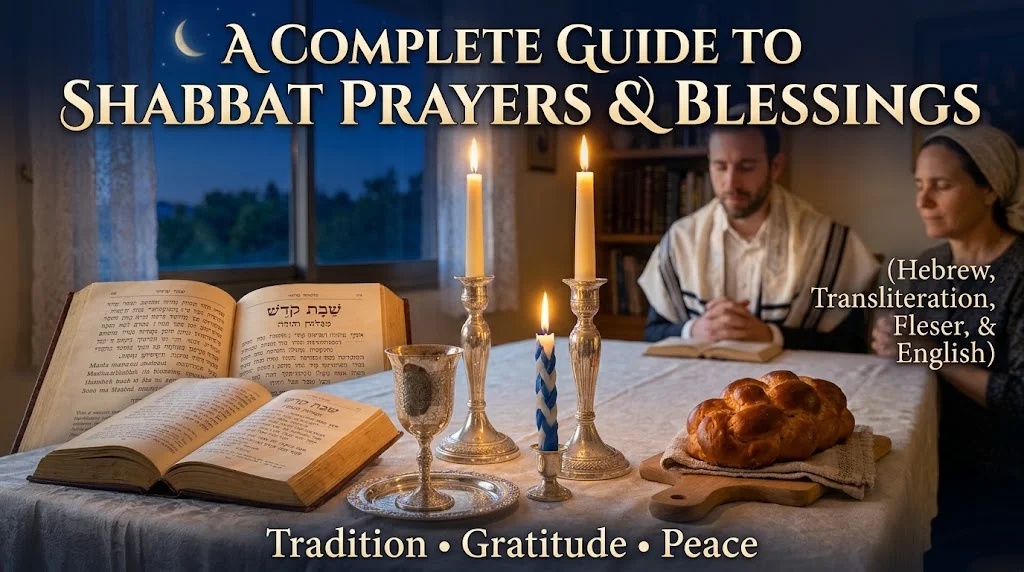
Shabbat is the Jewish Sabbath. It runs from sundown on Friday to sundown on Saturday. Families welcome it at home with blessings over candles, wine and challah.
This guide gives you every Friday night Shabbat blessing in Hebrew, transliteration and English. You will also learn when to say each one and how to do it. It works for beginners, interfaith families and anyone hosting a first Shabbat dinner.
The Friday night blessings go in this order: candles, blessing for the children, Shalom Aleichem, Eshet Hayil, Kiddush, hand washing and Hamotzi. A Grace After Meals closes the dinner.
Shabbat is still widely observed in the U.S. Pew Research found in 2020 that about 39% of Jewish Americans say they often or sometimes mark Shabbat in a personally meaningful way. You do not need to say every blessing. Start with one or two and build from there.
Table of Contents
Shabbat Candle Blessings in Hebrew and English
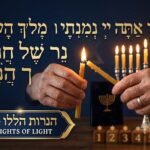
Lighting the candles marks the start of Shabbat. This is the moment Erev Shabbat (Friday evening) begins.
When do you light the Shabbat candles? Light them 18 minutes before sunset. The earliest time is plag haminchah, about an hour and a quarter before the day ends. Hebcal lists candle-lighting times for any U.S. city.
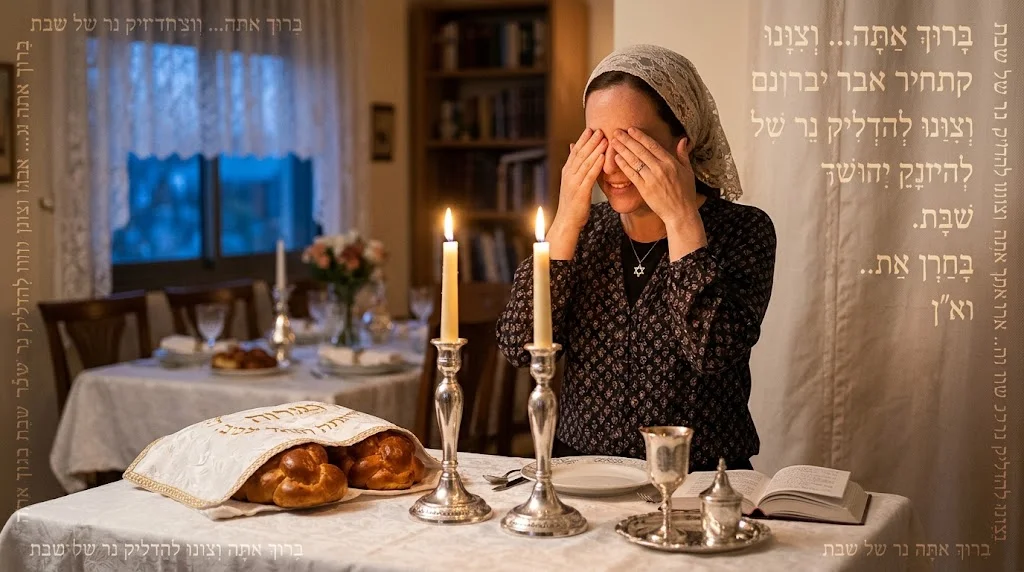
Who lights them, and how many? Traditionally, the woman of the home lights them. If no woman is present, a man does. Most people light two candles. Some families add one for each child.
How do you light the candles? Follow these steps:
Give a few coins to tzedakah (charity) first.
Light the candles near the dinner table.
Wave your hands over the flames, then cover your eyes.
Say the blessing.
Uncover your eyes and look at the lights.
Greet your family with “Shabbat Shalom.”
Why do you cover your eyes? A blessing normally comes before an act. But once you say this one, Shabbat has begun, and lighting a fire is no longer allowed. So you light first, then cover your eyes. When you uncover them, the candles feel newly lit.
Once lit, the candles are muktzeh. That means you should not move them until Shabbat ends.
Blessed are You, Lord our God, Ruler of the universe. You made us holy with Your commandments. You told us to light the Shabbat candles.
2. Blessing for the children
Parents often say this right after the candles. They place a hand on each child’s head. Boys and girls get a different opening line, then the same Priestly Blessing (Birkat Kohanim).
For boys:
Y’simcha Elohim k’Efrayim v’chiMenasheh.
May God make you like Ephraim and Menashe.
For girls:
Y’simech Elohim k’Sarah, Rivkah, Rachel v’Leah.
May God make you like Sarah, Rebecca, Rachel and Leah.
May God bless you and keep you. May God’s face shine on you and be kind to you. May God lift up His face to you and give you peace.
Joining as a guest or interfaith family: You can stand quietly, listen and say “Amen” at the end. Many hosts also welcome guests to light a candle of their own.
Apartment or dorm tip: Tealights or battery-safe candles work for this ritual if open flames are not allowed. Check your community’s custom.
Friday Night Shabbat Blessings at the Table
After the candles, the family sits down to dinner. The blessings follow a set order, and each one is short.
For those seeking a deeper connection with God through prayer, setting aside quiet moments for spiritual reflection can bring peace, clarity, and renewed faith. If you wish to explore a meaningful nighttime prayer practice, discover how Tahajjud prayer offers an opportunity to seek Allah’s guidance, forgiveness, and blessings during the peaceful hours of the night.
The table usually holds two challah loaves under a cover, a kiddush cup, wine or grape juice, a bowl of salt and a washing cup. The challah stays covered during Kiddush. Tradition says this spares the bread’s “feelings” while the wine is blessed first. The practical reason is simpler: the bread blessing normally comes first, so covering the bread lets the wine go first.
3. Shalom Aleichem (welcoming the Sabbath angels)
Families sing this song as they sit down. It has four verses. Here is the first. The other three open with Bo’achem l’shalom, Barchuni l’shalom and Tzeitchem l’shalom.
Peace be with you, angels of service, angels of the Most High. You come from the King of Kings, the Holy One, blessed be He.
4. Eshet Hayil (Woman of Valor)
Families sing this as a tribute to the woman of the house. It comes from Proverbs 31:10–31, a 22-verse poem. Each verse starts with the next letter of the Hebrew alphabet. Here is the opening line:
Eshet chayil mi yimtza, v’rachok mipninim michrah.
A woman of valor, who can find her? Her worth is far beyond pearls.
5. Kiddush for Friday night
Kiddush means “sanctification.” It sets Shabbat apart as sacred time. It recalls Creation and the Exodus from Egypt. The leader holds the cup in the right hand and stands while reciting. The cup should hold at least about 3.3 ounces. Everyone then drinks.
It opens with Vayechulu, which comes from Genesis 1:31 to 2:3:
Yom hashishi. Vayechulu hashamayim v’ha’aretz v’chol tz’va’am. Vaychal Elohim bayom hashvi’i m’lachto asher asah, vayishbot bayom hashvi’i mikol m’lachto asher asah. Vayevarech Elohim et yom hashvi’i vayekadesh oto, ki vo shavat mikol m’lachto asher bara Elohim la’asot.
The sixth day. The heavens and the earth were finished, and everything in them. On the seventh day God finished the work He had made. He rested on the seventh day from all His work. God blessed the seventh day and made it holy, because on it He rested from all His work of creation.
Blessed are You, Lord our God, Ruler of the universe, who creates the fruit of the vine.
No wine or grape juice? You can use another drink. Swap the last line for shehakol nih’yeh bid’varo, which means “by whose word all things came to be.”
Blessed are You, Lord our God, Ruler of the universe. You made us holy with Your commandments and took delight in us. In love and favor You gave us Your holy Shabbat, a reminder of Creation. It is the first of our holy days, recalling the Exodus from Egypt. You chose us and set us apart from all peoples. In love and favor You gave us Your holy Shabbat. Blessed are You, Lord, who makes Shabbat holy.
6. Netilat Yadayim (washing the hands)
Each person washes their own hands before eating bread. Pour water from a cup over the right hand two or three times, then the left. This is a purification ritual, not a cleaning one. Say the blessing before drying your hands. Nobody says “Amen” here, because each person says their own blessing.
Blessed are You, Lord our God, Ruler of the universe. You made us holy with Your commandments and told us to wash our hands.
Many people stay silent from this point until they eat the bread.
7. Hamotzi (blessing over the bread)
The head of the household lifts the two challahs, removes the cover and says the blessing. Then the challah is torn and passed around. Each piece is dipped in a little salt. Between Rosh Hashanah and Sukkot, people dip it in honey instead.
Baruch atah Adonai, Eloheinu melech ha’olam, hamotzi lechem min ha’aretz.
Blessed are You, Lord our God, Ruler of the universe, who brings forth bread from the earth.
Quick hosting checklist: candlesticks, a kiddush cup, wine or grape juice, two challahs with a cover, salt, a washing cup and a siddur or printed blessings.
Pronunciation tip: Say ch like the throat sound in “Bach.” Say ai like “eye.”
Shabbat Prayers After the Meal and on Saturday
Shabbat does not end at dinner. There are blessings after the meal, a Kiddush on Saturday and a Havdalah ceremony at the end.
8. Birkat Hamazon (Grace After Meals)
Birkat Hamazon, also called benching, follows any meal that includes bread. On Shabbat it opens with Psalm 126 (Shir HaMa’alot):
Shir hama’alot, b’shuv Adonai et shivat Tzion, hayinu k’cholmim.
A song of ascents. When the Lord brought the exiles back to Zion, we were like dreamers.
If three or more adults ate together, a leader starts with a short invitation called the zimmun. The prayer then moves through four main blessings. They thank God for food, for the land, for Jerusalem and for goodness. A small booklet called a bentcher holds the full text. You can also read the full Birkat Hamazon in Hebrew and English on Sefaria.
9. Zemirot (Shabbat table songs)
Zemirot are joyful songs sung around the table, often between courses or after the meal. Popular ones include Yom Zeh L’Yisrael, Menucha V’Simcha, Tzur Mishelo and Yom Shabbaton. Each family picks its own favorites.
10. Shabbat morning Kiddush
On Saturday, the Kiddush before lunch is shorter. It opens with V’shamru, from Exodus 31:16–17:
V’shamru v’nei Yisrael et haShabbat, la’asot et haShabbat l’dorotam brit olam. Beini uvein b’nei Yisrael ot hi l’olam, ki sheshet yamim asah Adonai et hashamayim v’et ha’aretz, uvayom hashvi’i shavat vayinafash.
The people of Israel shall keep Shabbat and observe it in every generation as a lasting covenant. It is a sign between Me and the people of Israel forever. In six days the Lord made heaven and earth, and on the seventh day He rested and was refreshed.
Then say the same wine blessing (borei p’ri hagafen) from the Friday night Kiddush.
11. Havdalah blessings
Havdalah means “separation.” It ends Shabbat after nightfall, when three stars appear. The leader holds a braided candle and a spice box, and fills a cup of wine. The blessings go in this order: wine, spices, flame, then the separation.
Wine: Borei p’ri hagafen. (who creates the fruit of the vine)
Flame: Borei m’orei ha’esh. (who creates the lights of fire)
Separation: Baruch atah Adonai, hamavdil bein kodesh l’chol. (Blessed are You, Lord, who separates the holy from the ordinary.)
Each of the first three blessings starts with the usual Baruch atah Adonai, Eloheinu melech ha’olam. Greet others with “Shavua tov,” meaning “a good week.”
Do customs differ by group? Yes. Orthodox and Chabad communities follow the most traditional timing and wording. Conservative and Reform communities may shorten texts, use more English or add new readings. In 2013, Pew found that 23% of Jewish Americans always or usually lit Sabbath candles. Practice varies widely, and none of it is wrong.
FAQs
What are the blessings for Friday night Shabbat?
The Friday night Shabbat blessings are the candle blessing, the blessing for the children, Shalom Aleichem, Eshet Hayil, Kiddush over wine, Netilat Yadayim (hand washing) and Hamotzi over the bread. After the meal, many families say Birkat Hamazon.
What are the 39 rules of Shabbat?
The 39 melachot are 39 categories of creative work that are avoided on Shabbat. They come from Mishnah Shabbat 7:2. They include sowing, plowing, baking, writing, building and kindling a fire. Rabbis based them on the work used to build the Tabernacle. How strictly people apply them depends on the community.
What is the blessing over the Shabbat candles?
The blessing begins Baruch atah Adonai, Eloheinu melech ha’olam. It ends l’hadlik ner shel Shabbat, meaning “to light the Shabbat candle.” In English: “Blessed are You, Lord our God, Ruler of the universe, who made us holy with Your commandments and told us to light the Shabbat candles.”
How do Jews say happy Sabbath?
The most common greeting is “Shabbat Shalom,” meaning “peaceful Sabbath.” Many say “Good Shabbos” or “Gut Shabbes,” which come from Yiddish. Some add “Shabbat Shalom u’Mevorach,” meaning “a peaceful and blessed Sabbath.” After Havdalah, people say “Shavua tov.”
Conclusion
Shabbat blessings are simple, and you can say all of them or just one. The order is easy to remember: candles, children, table blessings, then Grace After Meals. The words are ancient, but the point is warm and clear. It is about slowing down, giving thanks and gathering the people you love. This Friday, try the candle blessing and Hamotzi, then add more over time. Shabbat Shalom.
Abroy Hassan is the founder and writer behind Morning Prayer Hub, where he shares daily prayers and devotionals to help readers begin each day with faith, gratitude, and a quiet mind. He writes with a simple goal: to make prayer feel accessible, personal, and part of everyday life.