Many Catholics know the Our Father by heart in English but have never prayed it in Latin. This guide gives you the most common Latin prayers with simple English meanings and easy pronunciation tips.
You will find Catholic Latin prayers for the Rosary, the Mass, meals and daily life. Start with one prayer and add more at your own pace.
Table of Contents
What Are Latin Prayers and Why Do Catholics Still Pray Them?
Latin prayers are traditional Catholic prayers in the language of the Roman Rite. They have been prayed for many centuries.
Most come from the Latin Vulgate, the Bible translation St. Jerome finished in the late 300s. Church Latin is called Ecclesiastical Latin. It sounds softer than classical Latin and is easier to say aloud.
The Church has never dropped Latin. The Second Vatican Council taught that the use of Latin is to be preserved in the Latin rites (Sacrosanctum Concilium, no. 36). The same document asked that Catholics be able to say or sing the Mass parts that belong to them in Latin (no. 54).
The Traditional Latin Mass has its own history. Pope Benedict XVI widened its use in Summorum Pontificum (2007). Pope Francis placed new limits on it in Traditionis Custodes (2021). Check with your own diocese for the rules where you live.
Why do people still pray in Latin? Three reasons come up most:
It links Catholics across the world and across time.
The short, steady phrases are easy to memorize.
Many people find the sound calm and prayerful.
Are Latin prayers more powerful? No. The Church teaches that prayer is a relationship with God (see the Catechism, Part Four). Its strength comes from God and from faith, not from the language. Latin can help you focus, but a heartfelt prayer in English is just as real.
Basic Latin Prayers for Beginners (With English and Pronunciation)
Start here if Latin is new to you. These are the common Latin prayers every Catholic should know.
What is the basic prayer in Latin? It is the Sign of the Cross: In nomine Patris, et Filii, et Spiritus Sancti. Amen. It is short and used in nearly every prayer.
What is a famous Latin prayer? The Pater Noster (Our Father) is the most famous. It comes from Jesus’ words in the Gospel of Matthew. The Ave Maria and the Salve Regina follow close behind.
Signum Crucis (Sign of the Cross): In nomine Patris… means “In the name of the Father…”
Pater Noster (Our Father): Pater noster, qui es in caelis means “Our Father, who art in heaven.”
Ave Maria (Hail Mary): Ave Maria, gratia plena means “Hail Mary, full of grace.”
Gloria Patri (Glory Be): Gloria Patri, et Filio, et Spiritui Sancto means “Glory be to the Father, and to the Son, and to the Holy Spirit.”
Salve Regina (Hail, Holy Queen): Salve, Regina, Mater misericordiae means “Hail, Queen, Mother of mercy.” Tradition often credits it to Hermann of Reichenau in the 11th century.
Requiem Aeternam (Eternal Rest): Requiem aeternam dona eis, Domine means “Eternal rest grant unto them, O Lord.”
Anima Christi (Soul of Christ): Anima Christi, sanctifica me means “Soul of Christ, sanctify me.” It dates to the 14th century and is linked to St. Ignatius of Loyola.
Here is a simple Latin pronunciation guide for beginners:
Say each vowel clearly. Ave sounds like “AH-veh.”
Say “c” before e or i as “ch.” So caelis sounds like “CHEH-lees.”
Say “gn” as “ny.” So regnum sounds like “REH-nyoom.”
Pater Noster sounds like “PAH-ter NOH-ster.”
Try a 7-day plan. Pick one prayer. Say one line a day. Listen to a recording, then repeat it aloud. A few words at a time is enough.
Learn these words first:
Pater = Father
noster = our
gratia = grace
ora pro nobis = pray for us
How do you say “my lord” in Latin? Say Dominus meus for “my Lord.” When you speak to Him directly, say Domine, as in Domine Deus meus (“O Lord, my God”). The Gospel of John records Thomas saying Dominus meus et Deus meus, “My Lord and my God.”
Traditional Latin Prayers for the Rosary, the Angelus and the Mass
These traditional Latin prayers belong to devotions and church services. Together they make a full prayer life in Latin.
The Rosary in Latin uses the Credo, Pater Noster, Ave Maria, Gloria Patri, Fatima Prayer and Salve Regina. Many Catholics also pray the Litany of Loreto after it.
Credo (Apostles’ Creed): Credo in Deum Patrem omnipotentem means “I believe in God, the Father almighty.” It opens the Rosary.
Oratio Fatimae (Fatima Prayer): Domine Iesu, dimitte nobis debita nostra means “O Jesus, forgive us our sins.” Our Lady of Fatima asked for it in 1917, after each decade.
Angelus: Angelus Domini nuntiavit Mariae means “The angel of the Lord declared unto Mary.” It is prayed at 6 a.m., noon and 6 p.m.
Regina Caeli (Queen of Heaven): Regina caeli, laetare, alleluia means “Queen of heaven, rejoice, alleluia.” It replaces the Angelus in Easter season.
Memorare: Memorare, o piissima Virgo Maria means “Remember, O most gracious Virgin Mary.” Many link it to St. Bernard, but it dates to the 15th century.
Sub Tuum Praesidium: Sub tuum praesidium confugimus means “We fly to thy patronage.” It is one of the oldest known prayers to Mary, found on an early Greek papyrus.
Confiteor (I Confess): Confiteor Deo omnipotenti means “I confess to almighty God.” It is prayed at the start of Mass and in the Act of Contrition tradition.
Veni, Sancte Spiritus (Come, Holy Spirit): This Pentecost sequence asks the Holy Spirit to fill our hearts.
Sancte Michael Archangele (St. Michael Prayer): Defende nos in proelio means “Defend us in battle.” Pope Leo XIII promoted it in 1884.
Adoro Te Devote and Tantum Ergo: St. Thomas Aquinas wrote these for Eucharistic worship. You will hear them at Benediction.
Use this quick map:
Rosary: Credo, Pater Noster, Ave Maria, Gloria Patri, Fatima Prayer, Salve Regina
Mass and confession: Confiteor, Kyrie, Credo
Benediction: Tantum Ergo, Adoro Te Devote
Daily devotion: Angelus, Regina Caeli, Memorare
Going to a Latin Mass for the first time? Bring a Latin-English missal. Expect more silence and fewer spoken responses. Watch the people around you and follow along. No one expects you to know it all.
Latin Prayers for Meals, the Dead and Everyday Life
Latin prayers are not only for church. You can pray them at the table, at bedtime and when you remember the faithful departed.
Benedic, Domine, nos (Grace before meals): Benedic, Domine, nos et haec tua dona means “Bless us, O Lord, and these Thy gifts.”
Agimus tibi gratias (Grace after meals): Agimus tibi gratias, omnipotens Deus means “We give Thee thanks, almighty God.”
Angele Dei (Guardian Angel): Angele Dei, qui custos es mei means “Angel of God, my guardian dear.” It is short and good for children.
De Profundis (Psalm 129): De profundis clamavi ad te, Domine means “Out of the depths I cry to Thee, O Lord.” Catholics often pray it for the dead.
Te Deum: Te Deum laudamus means “We praise Thee, O God.” This ancient hymn of thanks is sung on great feasts and at year’s end.
Laudate Dominum (Psalm 116): Laudate Dominum, omnes gentes means “Praise the Lord, all ye nations.” It is only two verses long and easy to learn.
November is the month of the Holy Souls. It is a fitting time to pray Requiem aeternam and De Profundis.
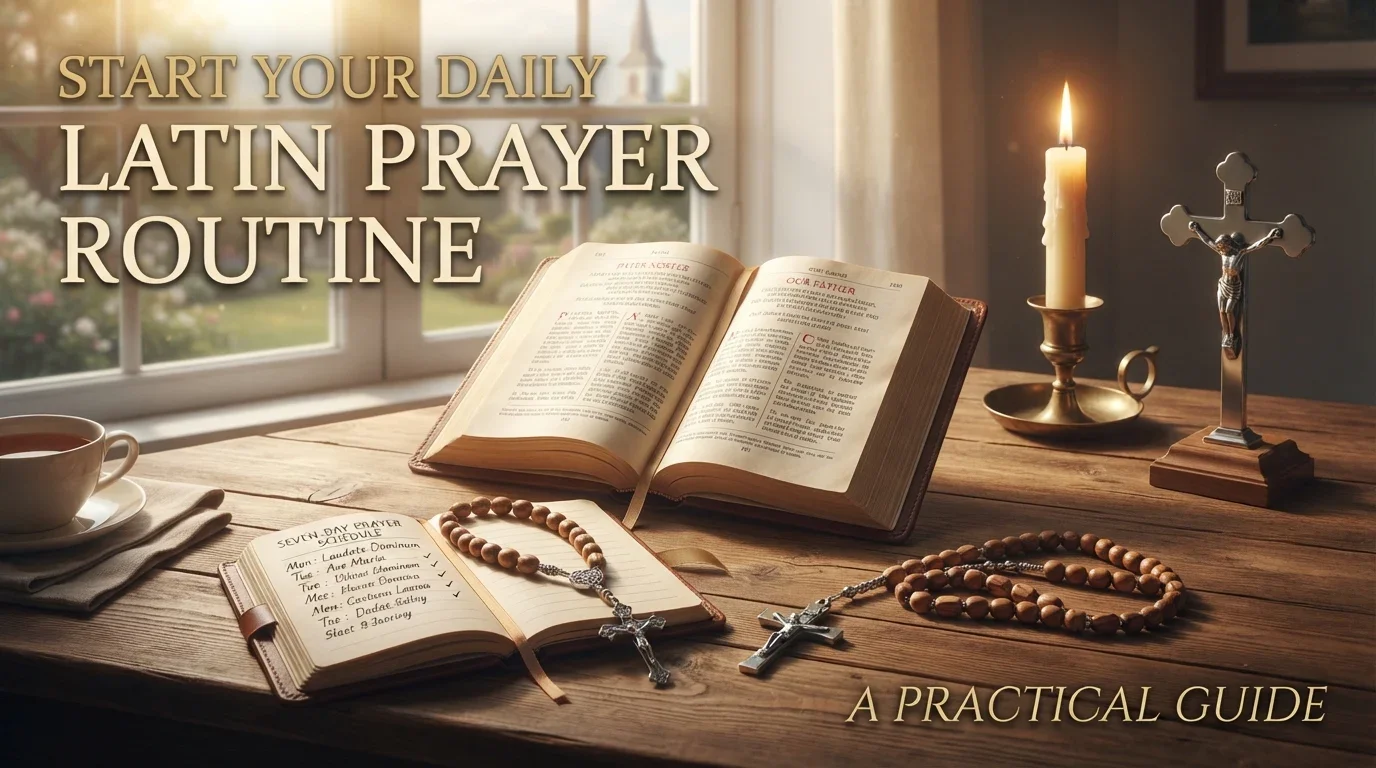
Build a daily Latin prayer routine like this:
Morning: Signum Crucis and Pater Noster
Meals: Benedic, Domine, nos
Noon: Angelus
Evening: Ave Maria and Angele Dei
Families and homeschoolers can add one prayer a month. Short lines work well for kids. Audio recordings and printable prayer cards help everyone keep a steady pace.
To start this week, follow these steps:
Pick one prayer.
Listen to it three times.
Say it aloud each day.
Add a second prayer after seven days.
A Latin-English prayer book or missal keeps the full texts at hand. Look for one that uses Ecclesiastical Latin so the words match what you hear at Mass.
Conclusion
Latin prayers are simple to begin and rich in meaning. Open the Sign of the Cross, the Pater Noster or the Ave Maria, and you are already praying in the language of the Church’s oldest traditions. You do not need to be a scholar. Take one prayer, learn it slowly and let it settle into your day. Start with a single line this week and add the next when you are ready.
Abroy Hassan is the founder and writer behind Morning Prayer Hub, where he shares daily prayers and devotionals to help readers begin each day with faith, gratitude, and a quiet mind. He writes with a simple goal: to make prayer feel accessible, personal, and part of everyday life.