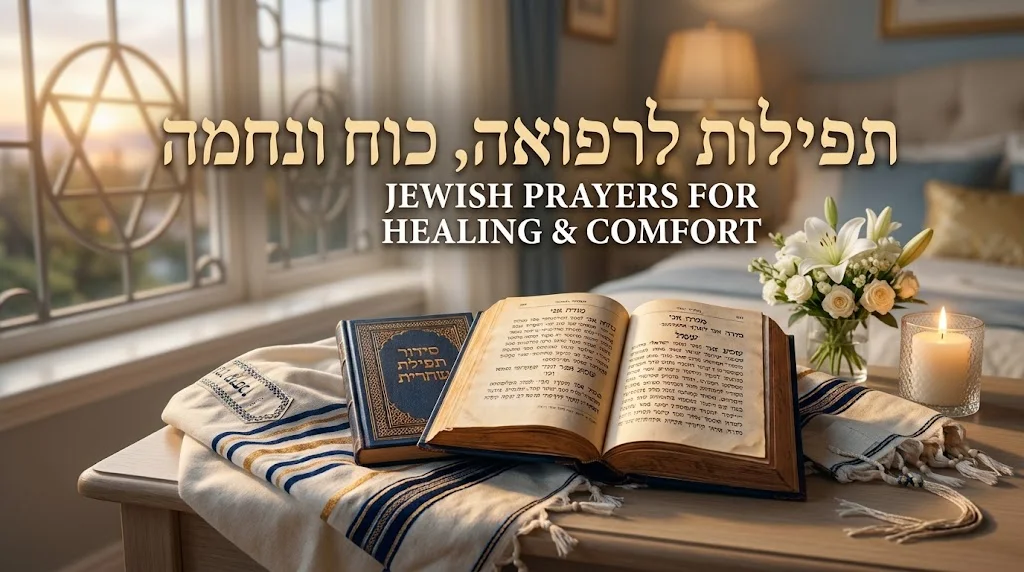
Jewish prayers give you words for every moment, from waking up to a hospital stay to a long trip. This list has 125 traditional Jewish prayers and blessings, each with a short meaning and a “say it” tip.
Prayer is part of everyday life for many families in the U.S. A Pew Research Center survey of 4,718 Jewish adults estimated about 7.5 million Jewish Americans, or 2.4% of the population. Many interfaith families and Christian readers also look for these prayers. You can read them from a siddur (prayer book), or find the full Hebrew texts on Sefaria. Bring kavanah, or heartfelt focus, and the words will carry more weight.
Table of Contents
Daily Jewish Prayers for Morning, Evening & Shabbat
Daily Jewish prayers follow three services: Shacharit (morning), Minchah (afternoon) and Ma’ariv (evening). The first 30 prayers cover the full day, plus Shabbat.
Modeh Ani: A short thank-you said right after waking. It has no divine name, so you can say it before washing your hands.
Netilat Yadayim: The blessing for washing your hands. Say it after you rise.
Asher Yatzar: Thanks to God for a body that works. Say it after using the restroom.
Elohai Neshama: It calls the soul pure and a gift. Say it in the morning blessings.
Birkat HaTorah: The blessing before Torah study. Say it before you read or learn.
Mah Tovu: It starts with a verse from Numbers about tents. Say it when you enter a synagogue.
Adon Olam: A well-loved medieval hymn about God as Master of the universe. Say it to open or close services.
Yigdal: A hymn built on Maimonides’ 13 principles of faith. Say it in the morning service.
Birchot HaShachar: A set of morning blessings for sight, clothing and strength. Say them as the day begins.
Barukh She’amar: It opens the psalms of praise. Say it at the start of Pesukei D’Zimra.
Ashrei: It is mostly Psalm 145, and many say it three times a day. Say it in morning and afternoon services.
Hallel: Psalms 113 to 118, sung with joy. Say it on festivals and Rosh Chodesh.
Yishtabach: The closing blessing of the praise section. Say it just before the Shema blessings.
Barekhu: The call to prayer. Say it with a minyan, a group of ten.
Shema: The core declaration that God is one, from Deuteronomy 6:4. Say it morning and night.
V’ahavta: It follows the Shema and asks you to love God with heart, soul and might. Say it right after the Shema.
Ahavah Rabbah: A blessing of great love for the Torah. Say it before the morning Shema.
Birkat Geulah: A blessing of redemption that recalls the Exodus. Say it right after the Shema.
Amidah (Shemoneh Esrei): The silent “standing” prayer. On weekdays it holds 19 blessings.
Aleinu: A prayer of praise that closes each service. Say it at the end.
Kaddish: A hymn that praises God’s greatness. Say it between sections of a service, and in mourning.
Ein Keloheinu: A joyful hymn that says none compares to our God. Sing it at the end of Shabbat services.
Uva L’Tzion: A verse of hope about a redeemer coming to Zion. Say it after the morning Amidah.
Hashkivenu: An evening blessing that asks God to lay us down in peace. Say it after the evening Shema.
Bedtime Shema: A short bedtime reading that repeats the Shema. Say it before you sleep.
Hamapil: A blessing thanking God for sleep. Say it as you go to bed.
Prayer for Protection at Night: It names four angels around you: Michael, Gabriel, Uriel and Raphael. Say it at bedtime, especially when you feel afraid.
Shalom Aleichem: A song that welcomes the Shabbat angels. Sing it on Friday evening.
Friday Night Kiddush: A blessing over wine that marks Shabbat as holy. Say it at the Friday meal.
Eshet Chayil: A tribute from Proverbs 31 to a woman of valor. Sing it at the Friday table.
Powerful Jewish Prayers for Peace
The Hebrew word shalom means peace, wholeness and safety. These Jewish prayers for peace come from the liturgy and from the Tehillim (Psalms).
Oseh Shalom: It asks the One who makes peace above to bring peace to us all. It ends the Amidah and Kaddish.
Sim Shalom: A request for peace, goodness and mercy. It closes the morning Amidah.
Shalom Rav: A close cousin of Sim Shalom. It closes the afternoon and evening Amidah.
Birkat Kohanim (Priestly Blessing): The three-line blessing of protection, grace and peace from Numbers 6. Say it at the end of services, or over your children.
Psalm 29: It describes the power of God’s voice and ends with a blessing of peace. Say it when you want to feel strength and calm.
Psalm 122: A song of longing for Jerusalem’s peace. Say it for the city and its people.
Psalm 85: A psalm where justice and peace meet. Say it in times of conflict.
Psalm 133: A short song about the joy of people living together in unity. Say it before family gatherings.
Psalm 34: It urges you to seek peace and chase after it. Say it when you need to let go of an argument.
Psalm 46: A psalm about God as a refuge when the world shakes. Say it in uncertain times.
Psalm 4: A bedtime psalm about lying down in peace. Say it when sleep won’t come.
Psalm 91: A psalm of shelter under God’s protection. Say it when you feel unsafe.
Psalm 131: A picture of a quiet soul, like a calm child. Say it when your mind races.
Psalm 27: It begins with “God is my light.” Many read it daily from the month of Elul to the end of Sukkot.
Psalm 25: A plea for guidance and forgiveness. Say it when you need a fresh start.
Psalm 126: A psalm about joy after sorrow. Many sing it before Grace After Meals on Shabbat.
Prayer for the Peace of Jerusalem: A request based on Psalm 122. Say it for the city and its people.
Prayer for the State of Israel: Many synagogues say it on Shabbat. It asks for safety, peace and wisdom for its leaders.
Prayer for Our Country: Jewish tradition includes a blessing for the government. Many U.S. synagogues say a version for the nation on Shabbat.
Prayer for Soldiers: A request for protection for those who serve. Say it for service members and their families.
Prayer for Peace in the Home (Shalom Bayit): A wish for a calm, kind household. Say it on Friday night.
Prayer for a Calm Mind: A short plea to quiet fear and worry. Say it before a stressful day.
Prayer for Forgiveness (Selichot): Pleas for mercy said before and during the High Holy Days. Say them when you want to make peace with someone.
Avinu Malkeinu: “Our Father, our King,” a plea for mercy. Say it during the Ten Days of Repentance.
Ana Bekoach: A seven-line poem of 42 words that asks for God’s help. Say it on Friday night, or when you need strength.
While Jewish prayers offer meaningful ways to seek peace, healing, and blessings through faith and tradition, the season of Advent provides another beautiful opportunity to reflect on hope, love, and spiritual renewal. Explore these Advent prayers for hope and peace to welcome the Christmas season with a grateful heart and a deeper sense of connection with God.
Jewish Prayers for Healing, Strength & Comfort
Jewish prayers for healing are often said by loved ones, not just the sick. Many people add the patient’s Hebrew name and the mother’s name.
Mi Shebeirach for the Sick: A public prayer for healing, usually said when the Torah is read. Share a name and the prayer goes up for them.
Refa’enu: The healing blessing in the Amidah. It asks God to heal with a full recovery.
Psalm 23: The shepherd psalm. Many say it at a bedside for comfort.
Psalm 121: “I lift my eyes to the mountains.” Say it for protection on a hard road.
Psalm 130: A cry from the depths that ends in hope. Say it in dark moments.
Psalm 102: A prayer of someone in pain. Say it when you feel weak.
Psalm 6: A plea to be healed and to have fear lifted. Say it in the early hours of worry.
Psalm 20: A hope that God will answer in a day of trouble. Say it before a test or a hard talk.
Psalm 30: A song of thanks for being healed. Say it after recovery.
Psalm 32: A psalm about relief after forgiveness. Say it when guilt feels heavy.
Psalm 41: It speaks of God’s care for people on a sickbed. Say it when you visit the ill.
Psalm 86: A plea for help from a humble heart. Say it when you feel small.
Psalm 103: “Bless the Lord, O my soul.” It praises God for healing and mercy. Say it with gratitude.
Psalm 107: A song of thanks from people who were rescued. Say it after danger passes.
Psalm 116: A psalm of love for God who hears you, and part of Hallel. Say it after a recovery.
Psalm 142: A prayer from a lonely hiding place. Say it when you feel alone.
Psalm 143: A request for guidance in a heavy hour. Say it when you can’t see the way.
Prayer Before Surgery: It asks for steady hands for the doctors and for a safe return to health. Say it the night before and the morning of.
Prayer Upon Entering the Hospital: A request for strength and for good care. Say it at the door.
Prayer for Strength in Illness: A plea for courage and a calm heart. Say it on hard days.
Prayer for a Caregiver: A wish for patience and rest for those who give care. Say it for a spouse, parent or nurse.
Prayer for a New Mother: A blessing for recovery and joy after birth. Say it in the first weeks.
Prayer for a Newborn: A request for health, safety and a good life for a baby. Say it when you meet them.
Prayer for a Sick Child: A parent’s plea for a child’s recovery. Say it softly at the bedside.
Prayer for Anxiety and Mental Health: A plea for peace of mind and for the courage to ask for help. Say it any time.
Prayer for Chronic Illness: It asks for daily strength, not just a cure. Say it each morning.
Birkat HaGomel: A blessing of thanks for surviving danger, such as illness or a long trip. Say it in front of a minyan.
Prayer for the Elderly: A blessing for strength, dignity and company in later years. Say it for a grandparent.
El Maleh Rachamim: A memorial prayer asking God to hold the soul of the departed. Say it at a funeral or a yahrzeit.
Mourner’s Kaddish: A praise of God said by mourners, often for 11 months after a parent’s death. Say it with a minyan.
Traditional Jewish Blessings & Prayers for Travel, Meals and Life’s Moments
A Jewish blessing, or brachah, marks even small moments. These final 40 traditional Jewish blessings cover travel, food, family, holidays and home.
Tefilat HaDerech (Traveler’s Prayer): It asks God to lead you in peace and bring you back safely. Say it once your trip begins.
Prayer for a Safe Flight: A modern use of the Traveler’s Prayer for the air. Say it as you board.
Prayer for a Road Trip: A short request for alert drivers and clear roads. Say it before you pull out.
Prayer for a Safe Return Home: A thank-you for arriving safely. Say it when you walk in.
Prayer for Children Traveling: A parent’s wish for a child’s safe journey. Say it at the airport or bus stop.
Birkat Hamazon (Grace After Meals): It thanks God for food, the land and Jerusalem. Say it after a meal with bread.
Hamotzi: The blessing over bread. Say it before you eat a meal.
Borei Pri HaGafen: The blessing over wine and grape juice. Say it before you drink.
Borei Nefashot: A short after-blessing for other foods and drinks. Say it after a snack.
Al HaMichyah: An after-blessing for grain foods, wine and certain fruits. Say it after a light meal.
Shehecheyanu: A blessing of thanks for reaching a new moment. Say it for first-time joys and holidays.
Kiddush Levana: A monthly blessing for the new moon. Say it outside under the moon.
Shabbat Candle Blessing: It brings in Shabbat with light. Many light the candles about 18 minutes before sunset.
Havdalah: A ritual of wine, spices and a braided candle that ends Shabbat. Say it on Saturday night.
Blessing for Sons: A Friday-night wish that boys grow like Ephraim and Manasseh. Say it with a hand on the head.
Blessing for Daughters: A wish that girls grow like Sarah, Rebecca, Rachel and Leah. Say it on Friday night.
Blessing Upon Seeing a Rainbow: It praises God who remembers the covenant. Say it when you see one.
Blessing on Thunder and Lightning: It honors the power of nature. Say it during a storm.
Blessing Upon Seeing Natural Beauty: A short thanks for creation. Say it at a mountain, ocean or sunset.
Blessing for a New Home (Chanukat HaBayit): A wish for safety and warmth in a new place. Say it when you move in.
Mezuzah Blessing: It marks a doorway as a Jewish home. Say it when you hang the mezuzah.
Sheva Brachot (Seven Blessings): The seven wedding blessings said under the chuppah and at meals that follow. Say them for a new couple.
Blessing for a Bride and Groom: A wish for love, joy and a lasting home. Say it at a wedding or engagement.
Prayer for Livelihood (Parnassah): A plea for honest work and enough to live on. Say it when you search for a job.
Nishmat Kol Chai: A long hymn of gratitude. Say it on Shabbat and festival mornings.
Prayer for Wisdom: It echoes King Solomon’s request for a listening heart. Say it before a big decision.
Bar and Bat Mitzvah Blessing: A parent’s blessing as a child takes on Jewish duties. Say it at the milestone.
Rosh Hashanah Blessing: A wish for a sweet new year, often said over apples and honey. Say it at the holiday meal.
Vidui (Yom Kippur Confession): A list of wrongs said aloud to ask for forgiveness. Say it on Yom Kippur.
Sukkot Blessing: It marks sitting in the sukkah and shaking the lulav and etrog. Say it each day of the holiday.
Chanukah Candle Blessings: Blessings said as you light the menorah. Say them each night of Chanukah.
Purim Blessing: Blessings said before and after the Megillah reading. Say them to celebrate the story of Esther.
Passover Seder Blessing: Blessings over four cups of wine and the story of the Exodus. Say them at the seder.
Shavuot Blessing: It marks the giving of the Torah at Sinai. Say it with Kiddush on the holiday.
Prayer for Charity (Tzedakah): A wish that your giving brings real help. Say it when you donate.
Prayer for Family and Friendship: A thank-you for the people you love. Say it at the table.
Blessing for a Husband and Wife: A wish for trust, kindness and joy together. Say it on an anniversary.
Prayer for Pregnancy and Fertility: It echoes Hannah’s heartfelt prayer for a child. Say it with hope and patience.
Hodu (Give Thanks): A call to thank God, taken from the Psalms. Say it in the morning service.
Closing Blessing (Yevarechecha): It echoes the first words of the Priestly Blessing: “May God bless you and keep you.” Say it to end the day, or to send someone off.
FAQs
What is the most powerful Jewish prayer?
The Shema is widely seen as the most powerful Jewish prayer. It declares that God is one, and many Jews hope to say it as their final words. The Amidah is also called central. Jewish tradition says the real power comes from sincere intention, or kavanah.
What is the main Jewish prayer?
The Shema is the main Jewish prayer. It comes from Deuteronomy 6:4 and is said every morning and night. The Amidah, or Shemoneh Esrei, is the central prayer of each service. It is said silently while standing.
What are the three Jewish prayers?
Jews pray three times a day. These services are Shacharit (morning), Minchah (afternoon) and Ma’ariv (evening). They match the three patriarchs and the Temple offerings. Some people also use “three prayers” to mean the Shema, the Amidah and Aleinu.
What are the Jewish 7 blessings?
The Sheva Brachot are the seven blessings said at a Jewish wedding. They are recited under the chuppah and at celebration meals after the wedding. They cover wine, creation, humanity, Zion’s joy and the happiness of the bride and groom.
Conclusion
Jewish prayer is simple at its core: say thanks, ask for help and bless the people around you. These traditional Jewish prayers for peace, healing and blessings have been said for centuries in homes, hospitals and synagogues. Pick one that fits today and say it slowly. Keep a siddur nearby, and share a prayer with someone who needs one. Even a short prayer said with care can bring comfort.
Abroy Hassan is the founder and writer behind Morning Prayer Hub, where he shares daily prayers and devotionals to help readers begin each day with faith, gratitude, and a quiet mind. He writes with a simple goal: to make prayer feel accessible, personal, and part of everyday life.