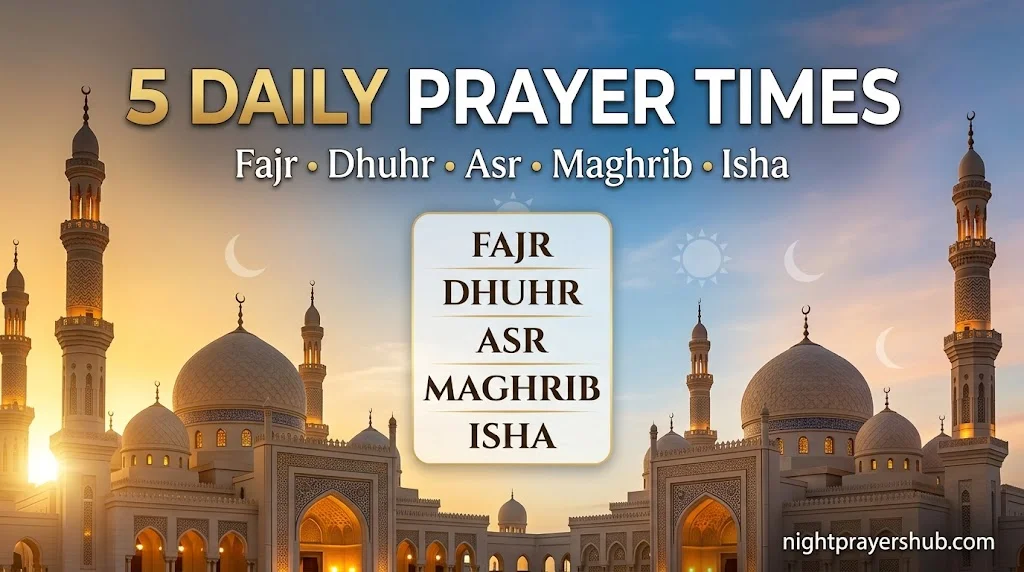
What are the prayer times today? Muslims pray five times a day: Fajr, Dhuhr, Asr, Maghrib and Isha. The exact salah times change with the date and your city. A namaz timing in New York will not match Houston or Los Angeles.
This guide gives you the five prayers in order, shows how today’s prayer times are worked out, and explains how to find accurate prayer times near you.
Table of Contents
Prayer Times Today: The Five Daily Salah in Order
Each prayer has its own window, set by the sun. Here is the order, with the fard rakaat (required units) for each.
Fajr: Starts at true dawn, called Fajr al-Sadiq. Ends at sunrise (Shuruq). It has 2 fard rakaat.
Dhuhr: Starts just after the sun passes its highest point (Zawal). Ends when Asr begins. It has 4 fard rakaat. On Fridays, Jumu’ah takes its place.
Asr: Starts in the afternoon. Ends at sunset. It has 4 fard rakaat.
Maghrib: Starts right at sunset. Ends when the red twilight fades. It has 3 fard rakaat. It is also the Iftar time in Ramadan.
Isha: Starts once twilight is gone. Runs into the night. It has 4 fard rakaat.
The Quran says prayer is set for believers at fixed times. That is why the five daily prayer times follow the sun so closely.
Some people also pray Tahajjud (Qiyam) in the last part of the night. It is optional, and it comes after Isha and before Fajr.
How Prayer Times Today Are Calculated
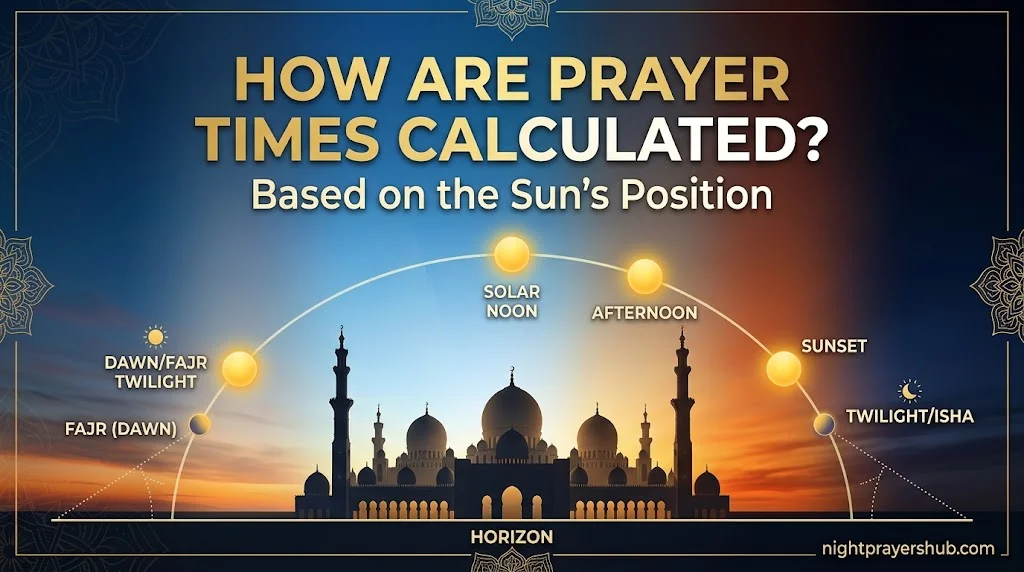
Prayer times are based on the sun’s position. Sunrise, sunset and solar noon move a little every day. That is why today’s prayer times shift by a minute or two from one day to the next.
Fajr and Isha use the sun angle below the horizon. Groups pick different angles, so their times differ slightly:
ISNA (Islamic Society of North America): 15° for Fajr and Isha. It is widely used across the USA and Canada.
Muslim World League: 18° for Fajr, 17° for Isha.
Egyptian General Authority of Survey: 19.5° for Fajr, 17.5° for Isha.
University of Islamic Sciences, Karachi: 18° for both.
Umm Al-Qura: 18.5° for Fajr, and Isha 90 minutes after Maghrib.
Asr also depends on the school of thought. In the Shafi, Maliki and Hanbali view, Asr starts when an object’s shadow equals its height. In the Hanafi view, it starts when the shadow is twice its height. A 6-foot pole is a good example. So Hanafi Asr is later.
Two things catch many people off guard.
Daylight Saving Time: Clocks in most of the USA go back an hour on November 1, 2026. Fajr and Isha will jump an hour earlier on the clock that morning.
High latitudes: In places like Seattle, Minneapolis and Anchorage, twilight can last almost all night in summer. Mosques there use a fallback rule, such as the middle of the night or one-seventh of the night. Ask your local masjid which one it follows.
You can check the sun’s position yourself with the NOAA solar calculator.
As you plan your prayers throughout the day, taking a moment to reflect and seek blessings can bring added peace and gratitude. For more meaningful words to begin or end your Saturday, explore these Saturday blessings and prayers for peace, joy, and success.
How to Find Accurate Prayer Times for Your Location
The best source matches your city and your local mosque’s method. A few small steps get you there.
Use your ZIP code or GPS. Even a short drive can change the time by a minute.
Pick the right calculation method. In the USA, ISNA is the usual choice.
Choose your Asr method. Set it to Hanafi or Shafi to match your school.
Check your masjid’s iqamah. The adhan (call to prayer) marks the start. The iqamah is the second call, usually 10 to 20 minutes later.
Turn on adhan alerts. Prayer apps such as Athan and Muslim Pro send a notification for each prayer.
Know your Qibla. For most of the contiguous USA, the Qibla direction points roughly northeast. A Qibla finder gives your exact bearing.
Print a monthly timetable. It helps if your phone has no signal at work or on the road.
Traveling? Muslims may combine Dhuhr with Asr and Maghrib with Isha on a journey. During Ramadan, Suhoor ends at Fajr (Imsak is a few minutes before), and Iftar starts at Maghrib.
The number of people who use these tools keeps growing. Pew Research Center estimated about 3.45 million Muslims in the USA in 2017, and projected 8.1 million by 2050.
FAQs
What time is Fajr prayer today?
Fajr starts at true dawn and ends at sunrise. In early October, that is often between 5:00 AM and 6:30 AM in most US cities. Check your city’s timetable for the exact minute.
What time is Dhuhr prayer today?
Dhuhr starts shortly after solar noon, when the sun passes its highest point. That is usually around 12:00 PM to 1:30 PM, depending on your city and Daylight Saving Time. On Fridays, Muslims pray Jumu’ah instead.
What time are Asr, Maghrib, and Isha prayers today?
Asr begins in the afternoon, Maghrib at sunset, and Isha after the evening twilight ends. Each one starts when the previous window closes, except Asr, which depends on whether you follow the Hanafi or Shafi method.
How can I find accurate prayer times for my location?
Use an app or website that reads your GPS or ZIP code. Set the calculation method to ISNA, choose your Asr method, and compare the result with your local mosque’s schedule.
Conclusion
The five daily prayers are Fajr, Dhuhr, Asr, Maghrib and Isha, and their times shift with the sun. Use your location, the right calculation method and your local masjid’s iqamah. Turn on alerts so you never miss today’s prayer times.
Abroy Hassan is the founder and writer behind Morning Prayer Hub, where he shares daily prayers and devotionals to help readers begin each day with faith, gratitude, and a quiet mind. He writes with a simple goal: to make prayer feel accessible, personal, and part of everyday life.