You don’t need long, polished words to reach God. A single honest sentence, prayed with faith, can shift a whole situation. That’s the real power of short prayers — they trade eloquence for urgency, and urgency is what moves Heaven.
This guide breaks down why short prayers work, what the Bible says about them, and how you can start praying them today.
Table of Contents
What Makes Short Prayers So Powerful
A short prayer isn’t a shortcut. It’s concentrated faith. When you cry out “Help me, Lord” in a moment of crisis, you’re not being lazy — you’re being honest. Scripture actually warns against the opposite habit. In Matthew 6:7, Jesus tells His followers not to “keep on babbling” like people who think they’ll be heard for their many words.
That single verse reframes everything. Prayer power doesn’t come from vocabulary. It comes from sincerity, from a heart that means what it says. A three-word prayer said with total trust can carry more spiritual weight than a ten-minute speech recited out of habit.
There’s also a practical side. Long, formal prayers can feel intimidating, especially for people newer to faith. Simple prayers remove that barrier. You don’t need the right phrasing — you just need to speak. That accessibility is part of why short, heartfelt prayers have stayed central to Christian practice for two thousand years.
Short Prayers in the Bible: Proof They Work
Scripture is full of brief prayers that produced massive results. These aren’t just nice stories — they’re a repeated pattern.
Paul’s fourteen-word command. In Acts 16:18, Paul turns to a demon-possessed woman and says, “I command you in the name of Jesus Christ to come out of her.” The spirit left immediately. No lengthy ritual — just a direct, faith-filled command.
Jabez’s thirty-word request. 1 Chronicles 4:10 records Jabez asking God to bless him, enlarge his territory, and keep him from harm. The very next line says, “God granted his request.” Short prayer, direct answer.
Hezekiah’s plea for more time. Facing death, King Hezekiah turns his face to the wall and prays a brief, tearful appeal in 2 Kings 20:2-3. God responds by adding fifteen years to his life (2 Kings 20:6).
The dying thief’s nine words. On the cross, a condemned criminal turns to Jesus and says, “Lord, remember me when you come into your kingdom” (Luke 23:42). Jesus answers instantly: “Today you will be with me in paradise” (Luke 23:43).
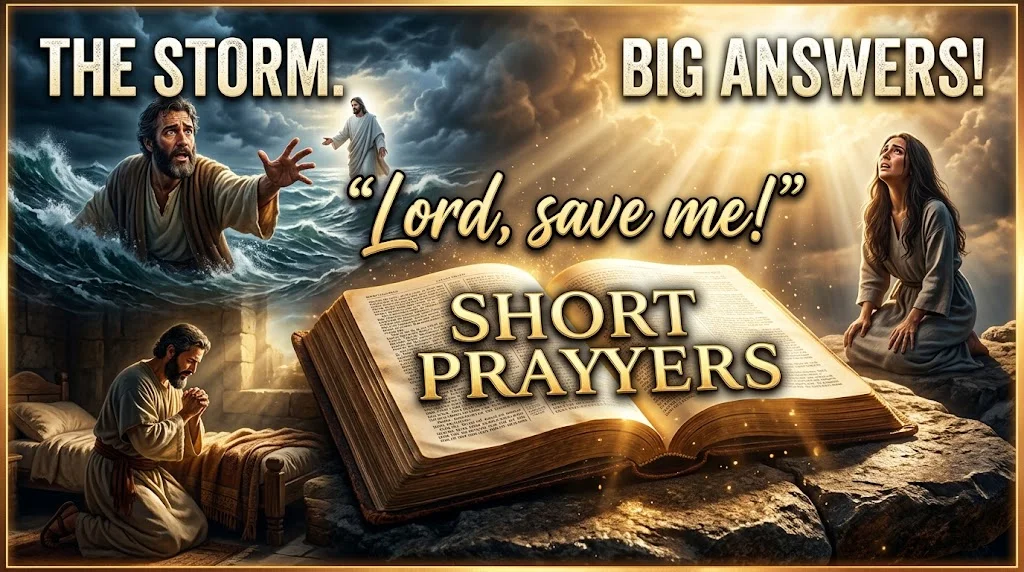
Peter’s cry while sinking. When Peter starts sinking into the waves, he doesn’t compose a speech. He shouts, “Lord, save me” (Matthew 14:30), and Jesus reaches out immediately.
Prayer
Approx. Word Count
Result
Paul’s command (Acts 16:18)
14 words
Spirit cast out instantly
Jabez’s request (1 Chronicles 4:10)
30 words
Request granted
Hezekiah’s plea (2 Kings 20:2-3)
22 words
15 years added to his life
The dying thief (Luke 23:42)
9 words
Promised paradise
Peter’s cry (Matthew 14:30)
3 words
Immediate rescue
The pattern is consistent: brevity paired with genuine faith gets a response.
How to Pray Short, Powerful Prayers Every Day
Building a habit of short, faith-filled prayers doesn’t require a formula, but a simple structure helps:
Name the need. Say exactly what’s wrong or what you’re asking for.
Speak with faith, not doubt. Believe God is listening as you speak.
Surrender the outcome. Trust His timing instead of demanding your own.
Here are simple prayers for common moments:
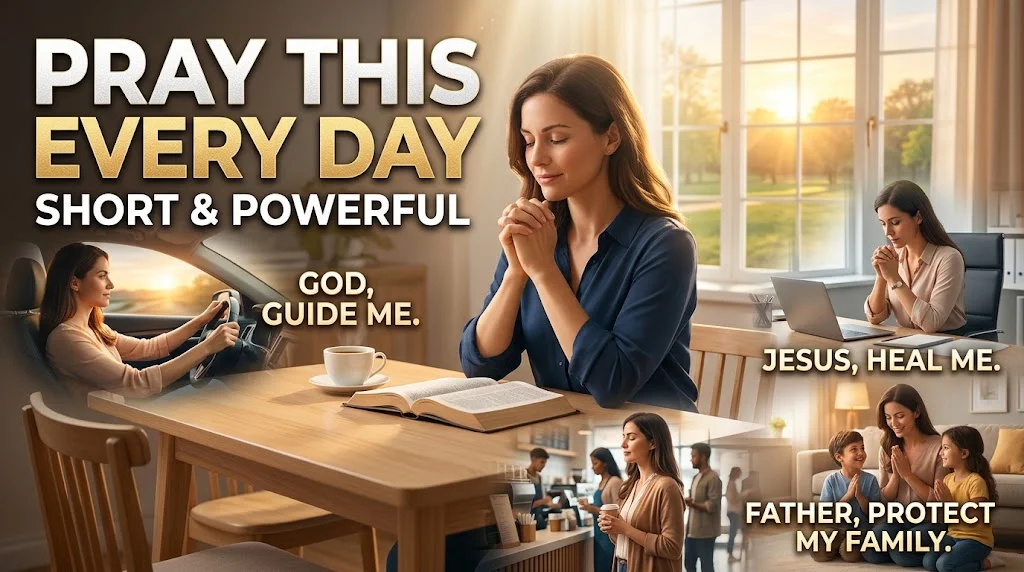
For anxiety: “Lord, calm my heart right now.”
For a decision: “God, show me the right path.”
For healing: “Jesus, touch my body and heal me.”
For protection: “Father, cover my family today.”
For gratitude: “Thank You, God, for this moment.”
You can pray these in the car, at your desk, or standing in line. The goal isn’t a scheduled quiet hour — it’s consistent, ongoing conversation with God throughout an ordinary day.
Praying with kids works the same way. Short, plain sentences (“Thank You, God, for my family”) are easier for children to understand and repeat than long, formal prayers, and they build a prayer habit early.
Prayer habits in America have shifted. According to Pew Research Center’s 2023-24 Religious Landscape Study, 44% of U.S. adults now pray daily, down from 58% in 2007 — a meaningful decline over roughly fifteen years (Pew Research Center). Younger adults pray far less often than older generations: only 27% of adults aged 18–24 report praying daily, compared with 58% of adults 74 and older (Faith and Leadership).
That gap matters because it often comes down to friction, not disbelief. Long prayer routines feel hard to start. Short prayers close that gap — they fit into a commute, a lunch break, or the sixty seconds before a hard conversation. Consistency, not length, is what rebuilds a prayer habit.
Pastor and author Jentezen Franklin explores this exact shift in his book The Power of Short Prayers. Franklin, senior pastor of Free Chapel and a New York Times bestselling author, argues that urgency, not eloquence, is what draws God’s attention — and that biblical breakthroughs almost always followed brief, desperate prayers rather than long, polished ones.
The book is available through major retailers, including Amazon (hardcover, Kindle, and Audible), Barnes & Noble, Christianbook, and Books-A-Million, as well as directly through Franklin’s ministry site.
FAQs
What does God say about short prayers?
Scripture doesn’t measure prayer by length. Matthew 6:7 warns against “vain repetition,” and James 5:16 says the prayer of a righteous person is powerful and effective — with no mention of word count. God responds to sincerity and faith, not eloquence.
Where can I buy The Power of Short Prayers by Jentezen Franklin?
The book is sold through Amazon, Barnes & Noble, Christianbook, and Books-A-Million, and can also be ordered directly through Jentezen Franklin’s official ministry website.
What is the 7 minute prayer?
The “7-minute prayer” is a popular devotional structure that breaks prayer into seven short segments — praise, waiting, confession, scripture, requests, intercession for others, and thanksgiving — with roughly one minute spent on each.
What is the powerful 3-word prayer?
One of the most cited three-word prayers in Scripture is Peter’s cry, “Lord, save me” (Matthew 14:30), prayed as he began sinking. Its power comes from total, immediate faith rather than length.
Which prayer is very powerful?
The Lord’s Prayer (Matthew 6:9-13) is widely regarded as the model prayer, since Jesus Himself taught it directly to His disciples as a pattern for how to pray.
What is the 3 o’clock miracle prayer?
The “3 o’clock prayer” refers to a devotional practice of pausing to pray at 3:00 p.m., linked by many believers to the hour of Jesus’s death on the cross (Matthew 27:45-46) as a moment of remembrance and breakthrough.
Conclusion
Prayer was never meant to be complicated. A short, honest sentence spoken in faith carries the same access to God as an hour-long prayer — sometimes more, because it comes from urgency rather than routine. Start small. Pray often. Watch what changes.
Abroy Hassan is the founder and writer behind Morning Prayer Hub, where he shares daily prayers and devotionals to help readers begin each day with faith, gratitude, and a quiet mind. He writes with a simple goal: to make prayer feel accessible, personal, and part of everyday life.