Sunnah prayers are the optional salah the Prophet Muhammad ﷺ prayed besides the fard (obligatory) prayers. The most stressed ones are the 12 daily Sunnah rak’ahs, known as ar-rawatib.
This guide gives you the types of Sunnah prayers, the exact rak’ah counts, and a simple way to pray them. It also covers witr, tahajjud and duha. You can fit all of it into a normal American workday.
Table of Contents
Types of Sunnah Prayers and Rak’ahs
Sunnah prayers fall into two groups. The rak’ah count changes from one prayer to the next.
What are the two types of Sunnah prayers? Sunnah Mu’akkadah means “emphasized.” The Prophet ﷺ prayed these almost every day. Sunnah Ghair Mu’akkadah means “non-emphasized.” He prayed them now and then. Both bring reward.
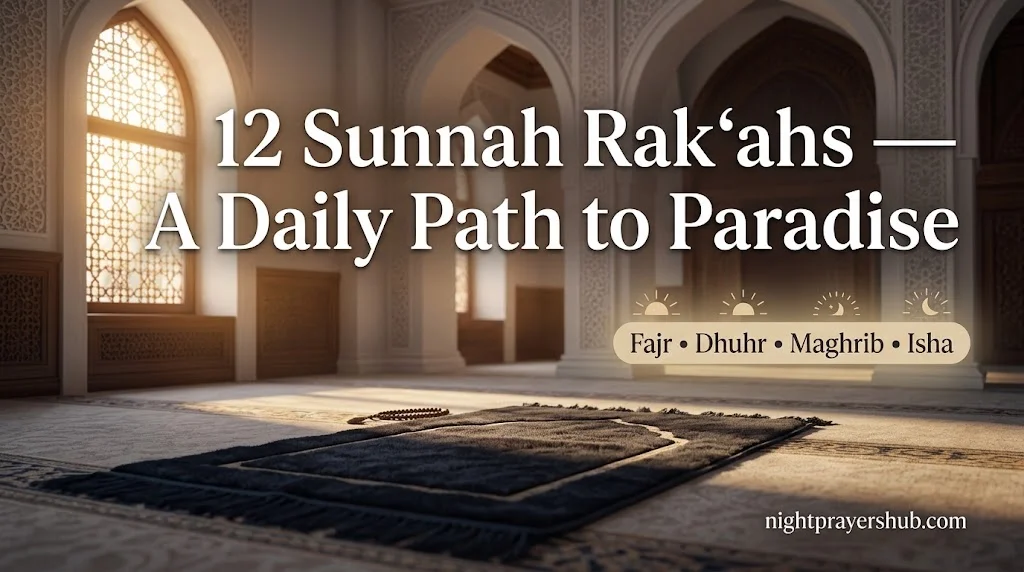
Which are the 12 Sunnah prayers? The 12 Sunnah rak’ahs are prayed around four of the five daily prayers:
Rak’ah numbers
Prayer
Sunnah rak’ahs
1 and 2
Fajr
2 before the fard
3 to 6
Dhuhr
4 before the fard
7 and 8
Dhuhr
2 after the fard
9 and 10
Maghrib
2 after the fard
11 and 12
Isha
2 after the fard
Asr has no emphasized Sunnah. Many scholars still recommend four rak’ahs before Asr.
What is the reward for praying 12 rak’ahs a day? Umm Habibah (may Allah be pleased with her) reported that the Prophet ﷺ promised a house in Paradise for the one who prays twelve rak’ahs each day and night (Sahih Muslim 728).
Why is the Fajr Sunnah so special? The Prophet ﷺ said the two rak’ahs before Fajr are better than this world and all it holds (Sahih Muslim 725). They are short, so there is no excuse to skip them.
How many Sunnah prayers are there? There are 12 emphasized rak’ahs every day. Add witr, tahajjud, duha, tahiyyatul masjid and salat al-istikhara, and the full list is longer.
Do all scholars count 12? No. Ibn Umar (may Allah be pleased with him) remembered ten rak’ahs: two before Dhuhr, two after Dhuhr, two after Maghrib, two after Isha and two before Fajr (Sahih al-Bukhari 1180). The 12 count adds two more before Dhuhr. Schools of fiqh may also differ on the optional rak’ahs. If you follow a specific school, ask your imam.
What about Friday and travel? On Jumu’ah, many people pray extra Sunnah rak’ahs before and after the khutbah. While traveling, most scholars say you can skip the ar-rawatib. You keep the Fajr Sunnah and witr.
As you follow today’s Fajr, Dhuhr, Asr, Maghrib, and Isha prayer times, it’s equally important to understand the prayers that complement the obligatory Salah. Learn more about Sunnah prayers, their types, rak‘ahs, and how to pray them to deepen your daily prayer routine.
How to Pray Sunnah Prayers Step by Step
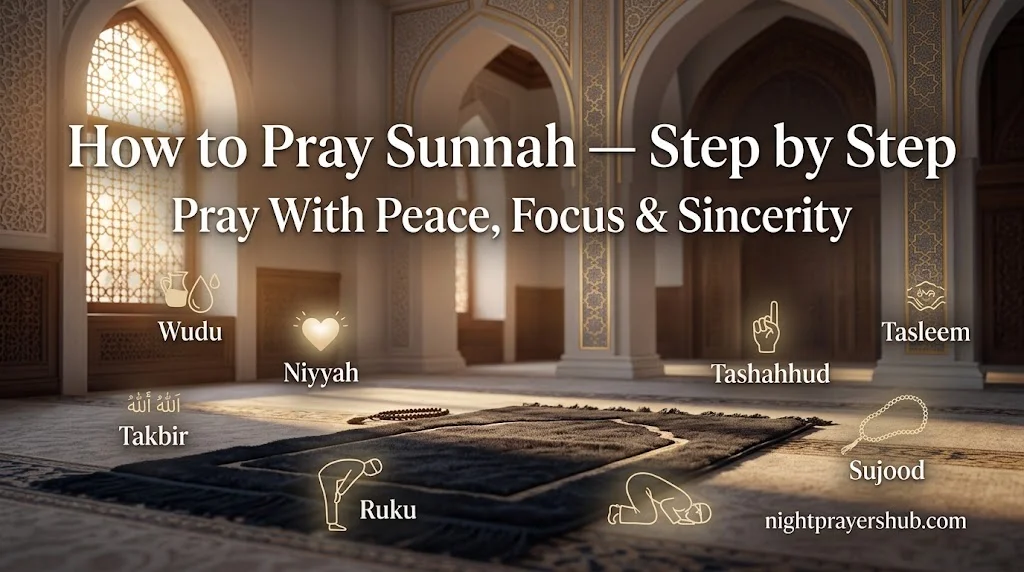
A Sunnah prayer has the same moves as any salah. It is just shorter. Here is the simple way to pray two rak’ahs.
What do you need before you start? You need wudu, clean clothes, a clean spot and the right time. Face the qiblah. In the U.S., most phones and prayer apps show the qiblah and the times.
How to pray Sunnah prayers:
Make the niyyah (intention) in your heart. Name the prayer, such as “Sunnah of Dhuhr.” You do not need to say it out loud.
Say the takbir: “Allahu Akbar,” and raise your hands.
Recite Al-Fatihah and another short surah. In the Fajr Sunnah, many people read Al-Kafirun in the first rak’ah and Al-Ikhlas in the second, as the Prophet ﷺ did (Sahih Muslim 726).
Go into ruku (bowing). Then stand up and go into sajdah (prostration) twice.
Rise for the second rak’ah and repeat the same steps.
Sit for the tashahhud and send blessings on the Prophet ﷺ.
End with the tasleem. Turn your face right, then left, saying the greeting of peace.
Why pray in sets of two? The Prophet ﷺ said that voluntary prayer by night and day is “two by two” (Abu Dawud 1295). So a four-rak’ah Sunnah is often prayed as two sets of two.
Where is the best place to pray Sunnah? At home. The Prophet ﷺ said the best prayer is the one prayed in your house, except the fard (Sahih al-Bukhari 731). That is good news for people who pray at work or school. You can do the Sunnah at home later.
What if you miss a Sunnah prayer? Do not stress. Sunnah prayers are optional. Many scholars say you can pray the missed Fajr Sunnah after sunrise.
When should you avoid optional prayers? Skip them from the Fajr prayer until sunrise, and from Asr until sunset (Sahih al-Bukhari 586).
Easy habit tips:
Start with only the two rak’ahs before Fajr.
Tie each Sunnah to its fard, so it feels automatic.
Keep a small prayer mat at your desk.
Add one new Sunnah each week.
Other Sunnah Prayers: Witr, Tahajjud and Duha
The ar-rawatib are not the only optional prayers. These nafl prayers add more light to your day and night.
What is the witr prayer? Witr is an odd number of rak’ahs, from one to thirteen. You pray it after Isha and before Fajr. For three rak’ahs, you can pray two, give the tasleem, then pray one more. The qunoot dua can be said in the last rak’ah.
What is tahajjud? Tahajjud is the night prayer. The best time is the last third of the night. Allah mentions it in the Qur’an, saying it is an extra prayer for the Prophet ﷺ (Qur’an 17:79).
What is the duha prayer? Duha is prayed in the morning, after sunrise and before Dhuhr. It can be 2, 4, 6, 8 or 12 rak’ahs. The Prophet ﷺ said that two rak’ahs of duha cover the charity owed for every joint in the body (Sahih Muslim 720).
What are tahiyyatul masjid and istikhara? Tahiyyatul masjid is two rak’ahs when you enter a mosque, before you sit. Salat al-istikhara is two rak’ahs followed by a special dua when you seek Allah’s guidance on a decision.
What about Taraweeh? Taraweeh is the night prayer of Ramadan. Many scholars link it to qiyam and witr.
What are the benefits of Sunnah prayers? The Prophet ﷺ said that on the Day of Judgment, if a person’s fard prayers fall short, their voluntary prayers will make up the gap (Tirmidhi 413). The prayers also bring barakah, calm and a closer bond with Allah.
How common is regular prayer among American Muslims? A 2017 Pew Research Center survey found that 42% of U.S. Muslims pray all five salah daily, and another 17% pray some salah every day. Sunnah prayers are a simple way to build on that habit.
FAQs
Here are quick answers to the most common questions.
Which are the 12 Sunnah prayers?
They are 2 rak’ahs before Fajr, 4 before Dhuhr, 2 after Dhuhr, 2 after Maghrib and 2 after Isha. Together they are called ar-rawatib.
Who are the three people Allah will not accept?
A hadith reported by Abu Dawud says the prayer of three people is not accepted: a person who comes to the prayer after its time has passed, a person who enslaves a free person, and a person who leads people in prayer while they dislike him. Scholars grade this narration differently, so it is not as firm as the hadith in the sections above. Most scholars also explain “not accepted” as a loss of reward, not as an invalid prayer. The lesson is to respect time, justice and people’s feelings. If you want a ruling, ask a qualified scholar.
How to pray Sunnah prayers?
Make the niyyah, say the takbir, recite Al-Fatihah and a surah, then bow and prostrate. Pray two rak’ahs and finish with the tashahhud and tasleem. Pray in sets of two. Praying at home is best.
How many Sunnah prayers are there?
There are 12 emphasized Sunnah rak’ahs each day. Other optional prayers include witr, tahajjud, duha, tahiyyatul masjid and istikhara.
Can I pray namaz without a bra?
Yes. A bra is not a condition for a valid prayer. A woman must cover her awrah, which is her whole body except the face and hands. Her clothes should be loose and not see-through. If you are unsure, ask a trusted scholar.
Conclusion
Sunnah prayers are small acts that bring big rewards. They protect your fard prayers and follow the way of the Prophet ﷺ.
Start small. Pray the two rak’ahs before Fajr this week. Then add one more Sunnah each week, and Allah will help you stay steady.
Abroy Hassan is the founder and writer behind Morning Prayer Hub, where he shares daily prayers and devotionals to help readers begin each day with faith, gratitude, and a quiet mind. He writes with a simple goal: to make prayer feel accessible, personal, and part of everyday life.