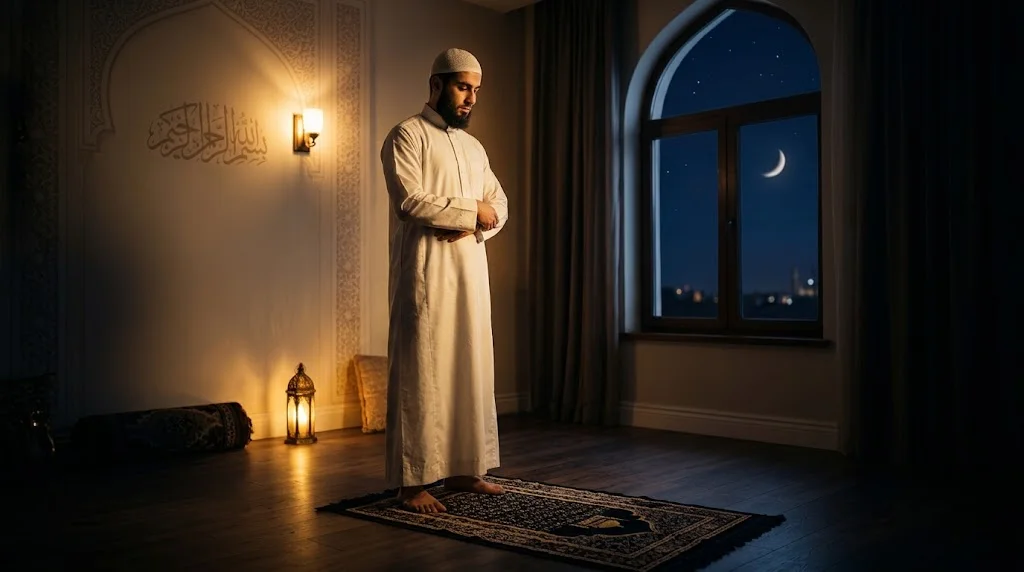
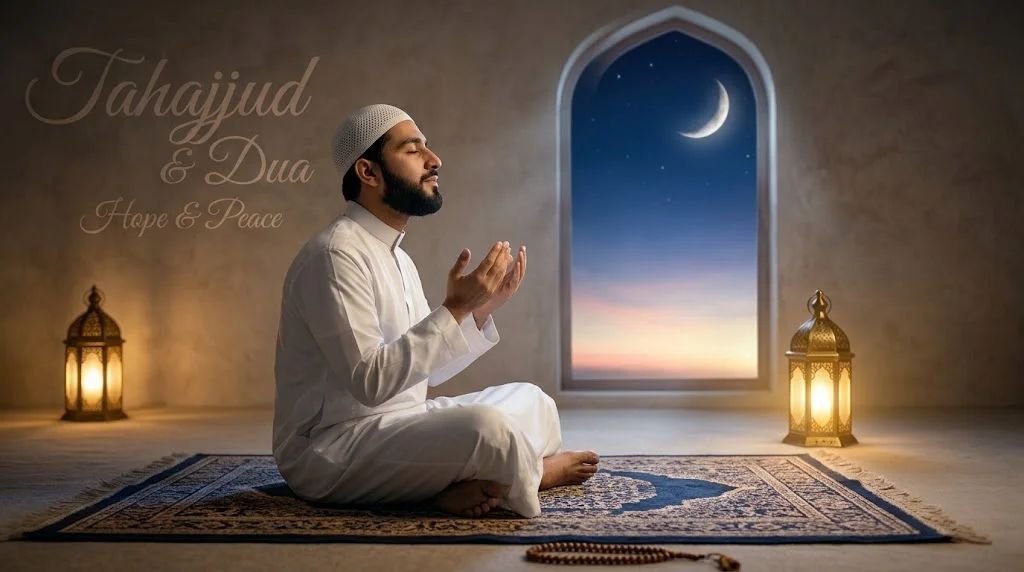
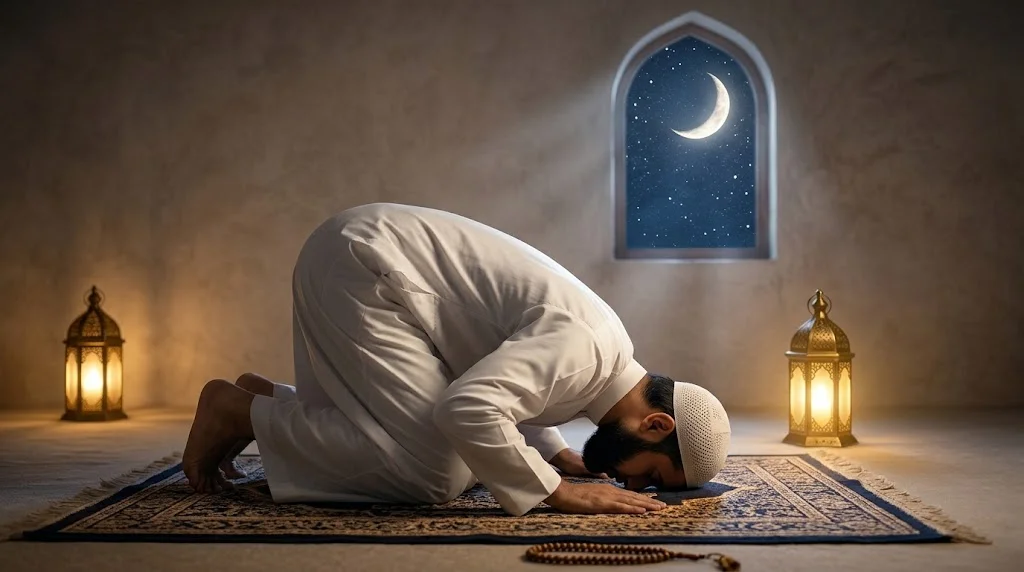
Tahajjud prayer is the voluntary (nafl) night prayer in Islam. You pray it after Isha and before Fajr. It is not required, but the Prophet Muhammad (PBUH) prayed it often.
This guide gives you the Tahajjud rakat count, the best time, and simple steps. It also helps you plan your night in a US time zone.
Table of Contents
How Many Rakats Are in Tahajjud Prayer?
Tahajjud has no fixed maximum. The minimum is 2 rakats. The Prophet’s (PBUH) reported practice ranged from 7 to 13 rakats, including Witr.
The Prophet (PBUH) said the night prayer is offered two by two. So you give salam after every 2 rakats. Sahih Muslim also records that he began the night prayer with two light rakats.
Aisha said his night prayer was 7, 9, or 11 rakats. She also said he never went past 11, in Ramadan or outside it. Ibn Abbas and Aisha also reported 13 rakats, counting Witr and the two Fajr sunnah.
Level
Rakats
Note
Beginner
2
Valid and rewarded
Steady
4 to 6
Pray as 2 + 2 (+ 2)
Prophetic practice
8 + Witr
Most often reported
Extended
10 or more + Witr
Only if you can keep it up
Witr is the odd-numbered closing prayer. The Prophet (PBUH) said to make it your last prayer at night. If you fear you will not wake up, pray Witr before you sleep (Sahih Muslim).
Is more always better? No. The Prophet (PBUH) told one companion to do what he could sustain. He also warned that your body and family have rights over you. Start small and stay consistent.
The Prophet (PBUH) called the prayer of Prophet Dawud (David) the most beloved to Allah. Dawud slept the first half of the night, prayed one third, and slept the last sixth.
Best Time for Tahajjud Prayer
Tahajjud time runs from Isha until Fajr begins. The last third of the night is the most rewarding part.
When you perform Tahajjud prayer, you can use this quiet time to ask Allah for clarity, wisdom, and guidance in every aspect of your life. If you’re facing a difficult decision or seeking direction, explore these heartfelt prayers for guidance to help you strengthen your faith, find peace, and trust Allah’s plan for your future.
The Prophet (PBUH) said Allah descends to the lowest heaven in the last third and asks who will call, ask, or seek forgiveness (also in Muslim). The Quran also praises those who seek forgiveness before dawn.
How do you find the last third of the night?
Find your local Isha and Fajr times.
Count the hours between them.
Divide that number by 3.
Subtract one third from the Fajr time.
Example: Isha at 8:30 PM and Fajr at 5:30 AM gives 9 hours. One third is 3 hours, so the last third begins at about 2:30 AM.
Many scholars count the night from Maghrib instead. That makes the last third start a little earlier. Check your local mosque’s timetable for the method it uses.
Summer nights are short, so the window is tight. Winter nights are long and give you more time. Daylight saving shifts the clock time twice a year, so recheck your times each season.
Can’t wake up late? You still have options:
The second third of the night also counts.
You can pray Tahajjud-style rakats before you sleep. The scholarly view is that this counts as Qiyamullail (night worship), even without sleep first.
Make the intention before bed. Sahih Muslim says praying Isha and Fajr in congregation earns the reward of standing the night.
Praying with the imam in Ramadan brings extra reward. If you finish Taraweeh with the imam, it is recorded as a full night of prayer (Tirmidhi).
How to Perform Tahajjud Prayer Step by Step
Tahajjud is prayed like any other sunnah prayer. You pray it in sets of two rakats.
First, make wudu and find a quiet, clean spot facing the qibla. The Prophet (PBUH) also used the siwak before praying at night.
Make the niyyah (intention) in your heart.
Say Takbir (“Allahu Akbar”) and fold your hands.
Recite Al-Fatihah, then a short surah.
Go into ruku and say the tasbih.
Stand up and say “Sami’ Allahu liman hamidah.”
Go into sujood, sit briefly, then do a second sujood.
Stand for the second rakat and repeat.
Sit for the tashahhud and salawat.
Give salam to the right and left.
Repeat in pairs, then close with Witr if you pray it.
What should you say after Tahajjud? Make dua. The Prophet (PBUH) said a servant is closest to his Lord in the last part of the night.
He also had a famous night dua that begins with praise of Allah as the Light of the heavens and the earth and asks for forgiveness of sins past and future. Add your own asks too: forgiveness, guidance, and ease.
Why pray Tahajjud? It builds closeness to Allah, inner peace, and discipline. The Prophet (PBUH) said it expiates sins and keeps you from wrongdoing.
Common mistakes to avoid:
Praying 4 rakats straight without salam.
Taking on too much, then quitting.
Staying up so late that you miss Fajr.
Giving up after one missed night. The Prophet (PBUH) warned against leaving a habit you had started.
What if you miss a night? Do not worry. The Prophet (PBUH) himself skipped it when he was sick.
FAQs
How many rakats are in Tahajjud?
The minimum is 2 rakats, and there is no maximum. Pray in pairs and give salam after each pair. The Prophet’s (PBUH) reported practice was 8 rakats plus Witr, or 11 to 13 in total.
What is the correct time for Tahajjud prayer?
Any time between Isha and Fajr. The best time is the last third of the night. Divide the night into three parts to find it for your city.
Can I pray only 4 rakat Tahajjud?
Yes. Pray them as 2 + 2, with salam after each pair. Then add Witr if you wish. Even 2 rakats is a valid Tahajjud.
Can I pray Tahajjud at 3 am?
Yes, if it falls between Isha and Fajr. In many US cities, 3 AM sits inside the last third, depending on your city and the season. It is a good time for dua and forgiveness.
Conclusion
Tahajjud prayer starts at 2 rakats, is prayed in pairs, and is best in the last third of the night. You do not need a perfect routine to begin. Start with two rakats this week, and add Witr when you feel ready.
Abroy Hassan is the founder and writer behind Morning Prayer Hub, where he shares daily prayers and devotionals to help readers begin each day with faith, gratitude, and a quiet mind. He writes with a simple goal: to make prayer feel accessible, personal, and part of everyday life.