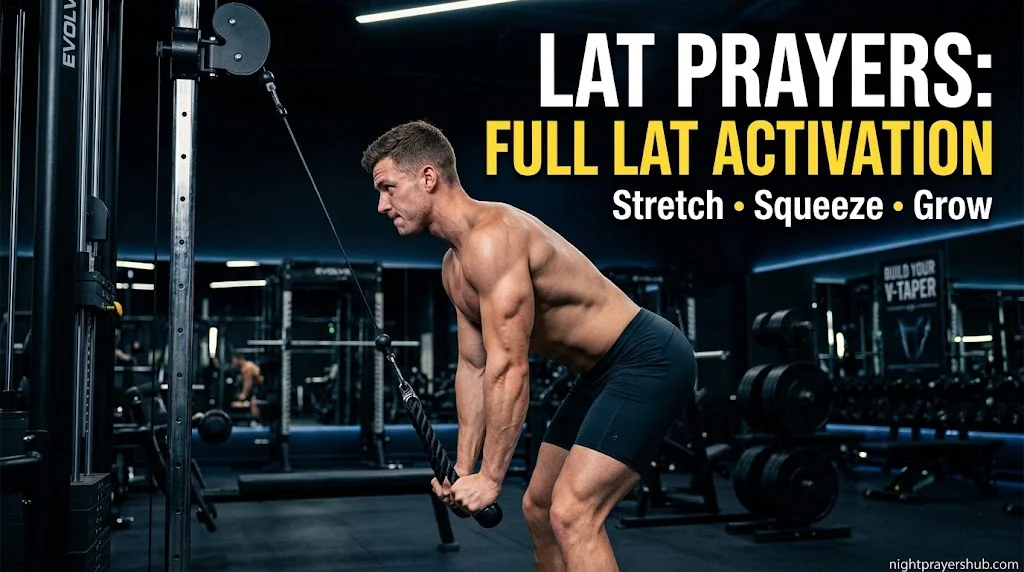
Lat prayers are a straight-arm cable pullover that trains your latissimus dorsi from a deep stretch to a hard squeeze. Few back moves keep the lats under load for that whole range of motion (ROM).
In the gym, “peace, protection and blessings” mean three things: calm, controlled reps, shoulder-safe form, and a wider back with a V-taper. This guide shows you how to get all three.
Table of Contents
What Are Lat Prayers and Why Do They Work?
The lat prayer exercise is a cable lat prayer done from a high pulley. You lean forward, keep your arms almost straight, and sweep the handle down to your thighs.
Coaches call it a “prayer” because the body folds and rises in a smooth, repeating motion. It is also known as a straight-arm cable pullover.
Here is why it works:
Lats peak in shoulder extension. EMG research shows the lats reach their highest activity during shoulder extension. That is the lat prayer movement.
Lats work well at long lengths. They are strongest near the anatomical position, but they lose little force when stretched, according to this length-tension study. That makes a loaded stretch very useful.
Rows and pulldowns have gaps. The lats have almost no leverage with the arms fully overhead or the elbows far behind the body. So tension drops at the top of a pulldown and the end of a row.
Lat prayers fill those gaps. You move your torso so the resistance curve matches your strength curve. Lean forward for the stretch, then lean back for the peak contraction.
What muscles do lat prayers work? The main muscles are the lats, teres major, and posterior deltoid (rear delts). The pecs, serratus anterior, and core assist.
The long head of the triceps also joins in. It helps extend the shoulder, and straight-arm pulldowns can activate it more than a barbell bench press. Pressing alone does not grow this head much.
The benefits include:
Full-ROM lat hypertrophy
A wider V-taper
Better triceps balance
A strong mind-muscle connection
A shoulder-friendlier option than the dumbbell pullover
For those seeking a deeper and more structured devotional practice, exploring the 15 Prayers of St. Bridget can offer another meaningful way to reflect, seek spiritual protection, and strengthen faith through prayer.
How to Perform a Lat Prayer: Step-by-Step Cable Form
Good form makes this move work. Here is the quick version for how to do lat prayers.
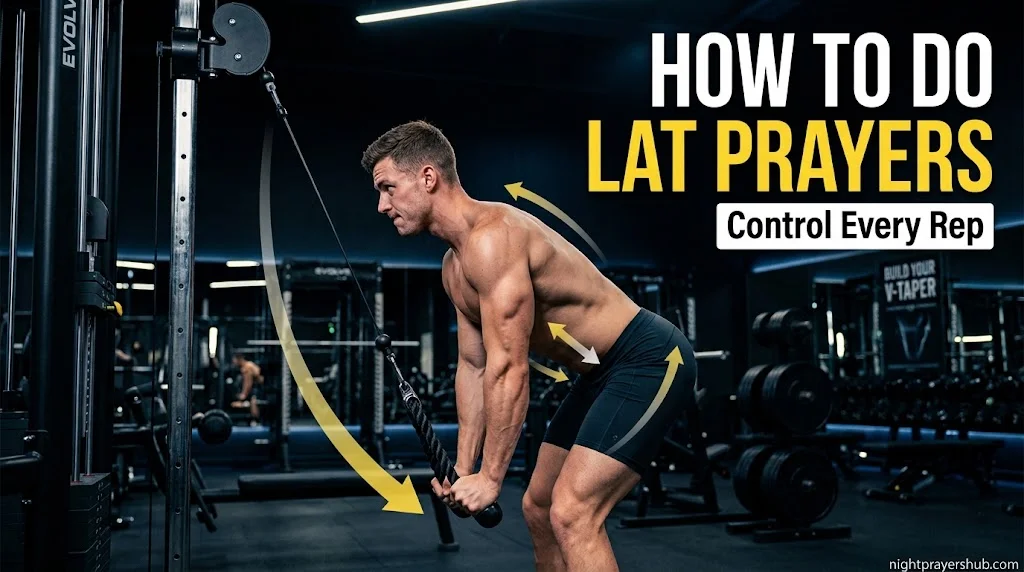
How to perform a lat prayer:
Set the cable pulley high. Clip on a rope, V-grip, or straight bar.
Grab the handle and step back. Hinge at the hips so your arms reach overhead and your ears sit between your arms.
Keep your arms almost straight. A slight bend of about 120–170° keeps tension on the lats, not the joints.
Pull the handle down in an arc toward your thighs. Lean back a little as you go.
Lift your chest just enough to clear the cable. Do not lift more than that, or you lose stretch at the top.
Stop when your elbows line up with your torso. Squeeze your lats.
Return slowly. Control the eccentric phase and sink into the stretch.
A few cues help:
Start the pull with your shoulders, not your elbows.
Brace your abs and keep your feet flat.
Lean in for more stretch. Lean back or step away from the tower for a harder squeeze.
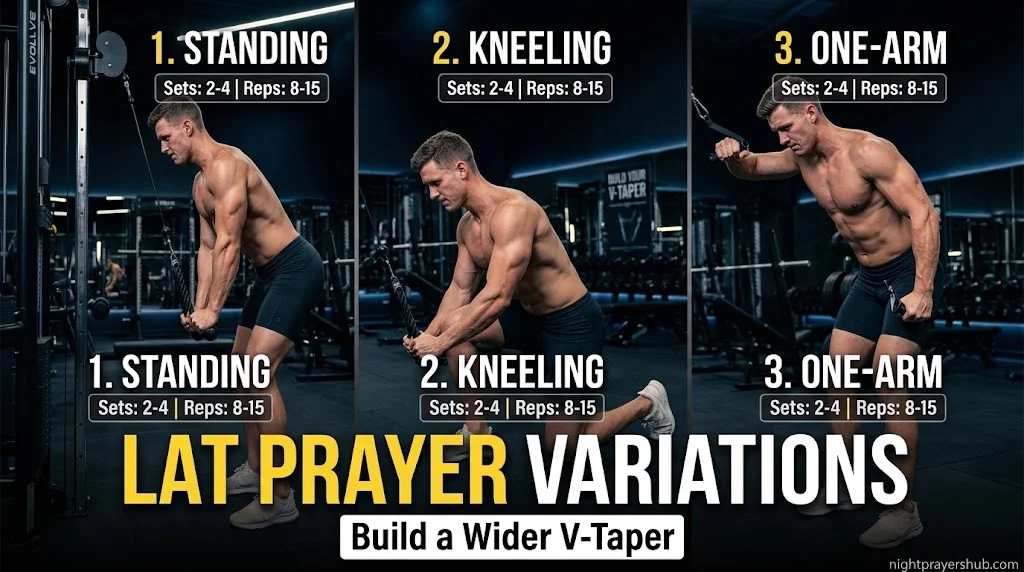
How many sets and reps should you do? Most lifters use 2–4 sets of 8–15 reps with a slow 2–3 second lowering phase. Chase range and tension, not heavy weight.
Where does it fit in a workout? Do it first in a back day, or after a vertical pull such as a lat pulldown or pull-up.
There are easy lat prayer variations:
Kneeling: helpful when the weight passes about two thirds of your bodyweight.
Kayak style: alternate sides as you pull.
One-arm: use a single handle.
Different handles: a rope, V-grip, or W-grip can change how it feels.
As you continue seeking peace, protection, and divine blessings, Saturday blessings and prayers can offer a meaningful way to begin the weekend with gratitude, hope, and renewed faith.
Lat Prayer Safety: Common Mistakes and How to Relax Your Lats
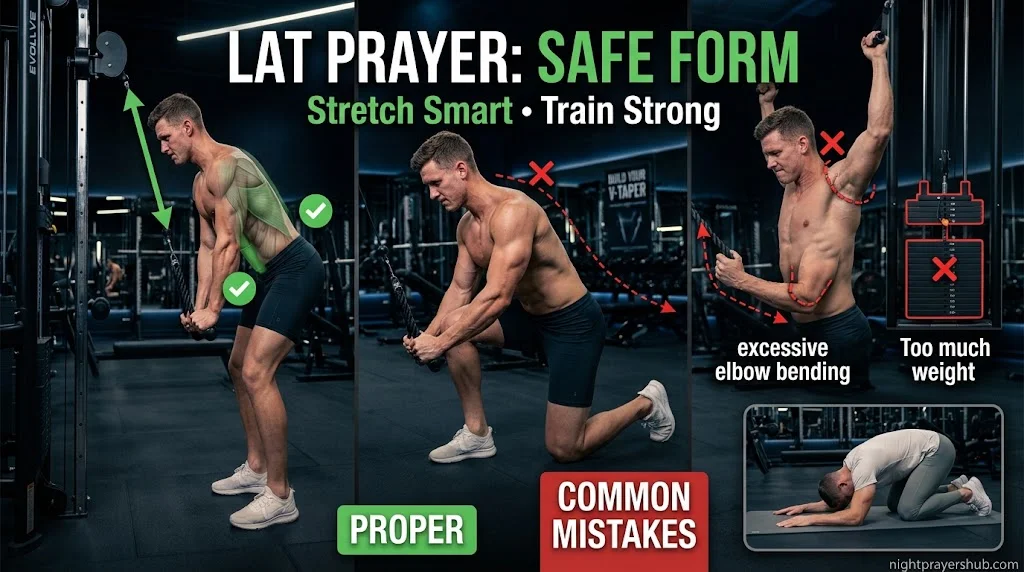
This move stretches the glenohumeral joint near its end range. A little care keeps it safe.
Avoid these common mistakes:
Bending your elbows. This turns it into a triceps pushdown.
Going fully overhead. The lats lose tension, and the shoulder takes the strain.
Pulling the elbows behind your body. The lats have little leverage there.
Rushing the turnaround. A fast reversal puts heavy load on a stretched shoulder.
Using too much weight. Form beats load here.
If your shoulders feel pinched, try a different grip width or attachment. You can also stop the stretch where it still feels comfortable. See a doctor or physical therapist if pain lingers.
How do you relax your lats after training? Try these:
A gentle lat stretch at a rack or doorway
Child’s pose with your arms reaching forward
Light foam rolling along the side of your back
Slow diaphragmatic breathing
Add a short warm-up before your first set, and keep your weekly back volume steady.
FAQs
How to perform a lat prayer?
Set a high cable, hinge forward with your arms overhead, and keep them nearly straight. Pull the handle to your thighs while leaning back slightly. Pause at the squeeze, then return slowly into a full lat stretch.
Are lat prayers a good exercise?
Yes. They train the lats through a full range of motion and keep mechanical tension high. They also add triceps long-head work. They are an advanced move, so learn the form with light weight first.
How do I relax my lats?
Use lat stretches, child’s pose, foam rolling, and slow breathing. Warm up before training, and ease off volume if your back feels tight for days.
What is another name for lat prayer?
It is also called a cable lat prayer or a straight-arm cable pullover. A close cousin is the straight-arm pulldown.
What to do instead of lat prayers?
Try the straight-arm pulldown, dumbbell pullover, lat pulldown, or pull-up. Each trains the lats, though none matches the full stretch-to-squeeze tension of a lat prayer.
Conclusion
Lat prayers bring peace through calm, controlled reps. They bring protection through smart form, and blessings through a stronger, wider back. Add them to your next back day, start light, and let the stretch do the work.
Abroy Hassan is the founder and writer behind Morning Prayer Hub, where he shares daily prayers and devotionals to help readers begin each day with faith, gratitude, and a quiet mind. He writes with a simple goal: to make prayer feel accessible, personal, and part of everyday life.